
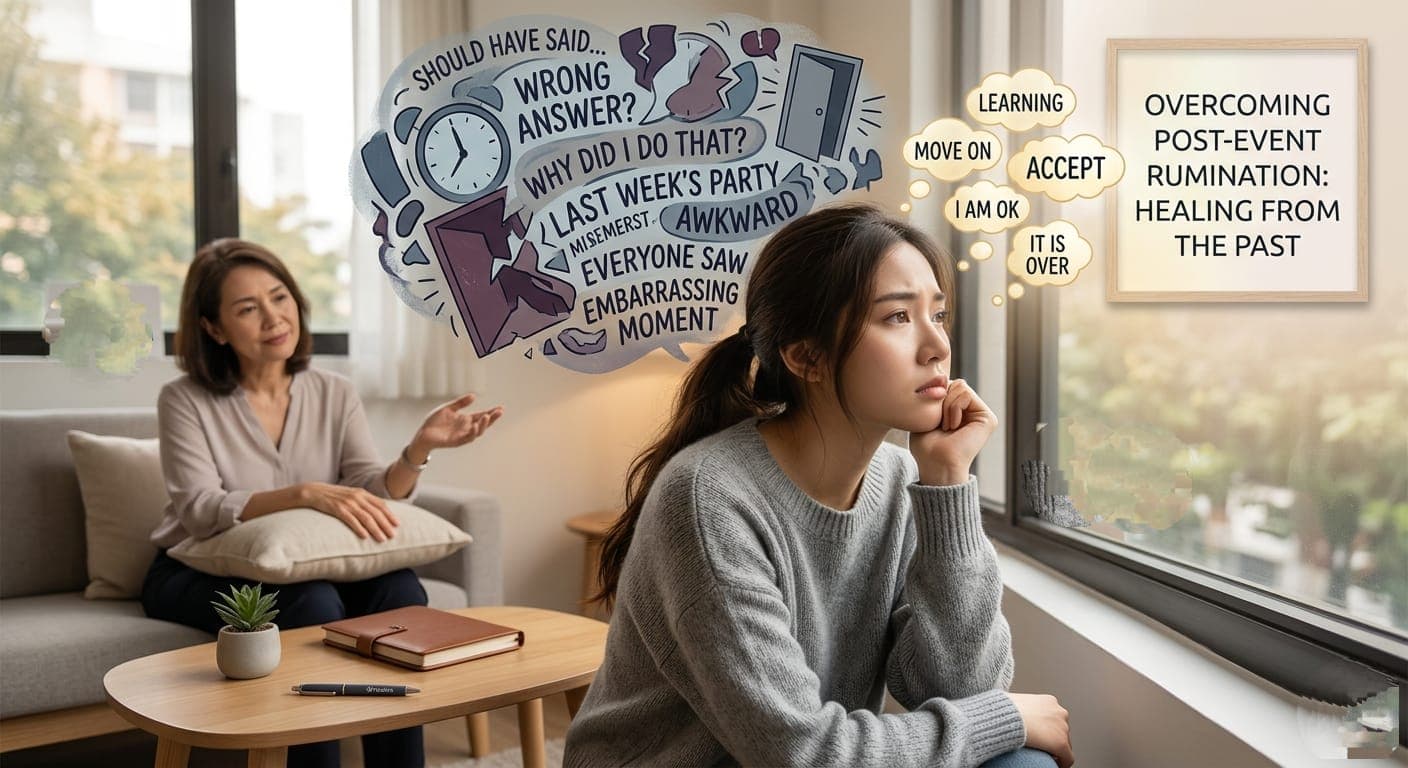
Introduction:
Imagine this: You just came back from a social gathering, a job interview, or a casual dinner with friends. The event went well, but the moment you lie down in bed, your brain starts a cruel replay of the entire day.
"Why did I say that stupid joke?"
"Did they think I was awkward when I laughed?"
"I should have handled that conversation better."
Sound familiar? In the world of psychology and counseling, this endless loop of analyzing past events is known as Post-Event Rumination (PER).
What is Post-Event Rumination?
Post-Event Rumination is the tendency to repeatedly review and critically evaluate one's performance after a social situation. Instead of remembering the good moments, our brain selectively focuses on perceived flaws, mistakes, or awkward silences. It is highly linked with Social Anxiety Disorder (SAD), but anyone can experience it from time to time.
The Toxic Cycle of PER
We frequently meet individuals who are mentally exhausted by this habit. PER creates a toxic cycle:
The Event: You attend a social interaction.
The Replay: Your brain reviews the event with a negative bias.
The Distortion: You blow minor details out of proportion.
Anxiety: You feel ashamed, leading to a drop in self-confidence and a fear of future social events.
Counseling-Based Strategies to Break the Cycle
Overcoming post-event rumination requires training your mind to process events objectively. Here are some evidence-based counseling strategies to help you stop the replay button:
1. Cognitive Reframing (Challenge Your Thoughts)
Our anxious thoughts are rarely facts. When your brain tells you, "Everyone thought I was boring," challenge it. Ask yourself: "Do I have actual proof, or is this just my anxiety talking?" Shift from emotional thinking to logical thinking.
2. The "So What?" Technique
Accept that minor awkward moments happen to everyone. If you made a minor slip-of-the-tongue, ask yourself, "So what? Will this matter in 5 years? Or even 5 weeks?" Most of the time, the answer is a resounding no.
3. Practice Mindfulness
Rumination keeps you trapped in the past. Mindfulness pulls you back into the present. When you catch your mind drifting into the past event, gently guide your focus back to your current surroundings - the weight of your feet on the floor, the sound of the fan, or your breath.
4. The Spotlight Effect Awareness
Understand that people generally focus on themselves, not on you. This is known as the Spotlight Effect. Others are too busy worrying about their own flaws to analyze yours.
A Note from Healora Wellness Centre
Your mind can be a beautiful place, but it can also feel like a prison when trapped in rumination. You cannot change the past, but you can change how much power you give it over your present.
If post-event rumination is causing you distress, sleeplessness, or making you avoid social situations, remember that you don’t have to fight this alone.
At Healora Wellness Centre, our experienced counselors are here to help you unpack these thoughts, rebuild your self-esteem, and guide you toward a more peaceful mind. Reach out to us today - let’s talk.